Tuesday, November 29, 2005

National call to combat climate change invoked by new state premier

Whether he is for real or spinning, the guy with the state's top job is making a big call to Kyoto Protocol cynic and Australian Prime Minister, John Howard.
Recently I wrote to the Prime Minister requesting him to convene a three-day national summit in the first half of next year on climate change and greenhouse gas emissions trading. The NSW Government believes a market-based approach is needed to tackle the problem of carbon emissions. The NSW Greenhouse Gas Abatement Scheme introduced in 2003 was the world's first mandatory emissions trading scheme. Earlier this year we extended the scheme from 2012 to 2020 and beyond until a national emissions trading scheme is established.

Such a scheme would provide greater business and environmental certainty for Australia as carbon-dependent economies are forced to make significant emissions reductions to contribute to the abatement of global climate change. There has been a significant shift in the business sector's opinion and also strong support from conservationists. The Howard Government, however, will not participate in this vital work

As proposed to the Prime Minister, such a scheme should be the focus for the national summit which could also discuss the promotion of clean technologies, energy efficiencies and the use of taxation policies to drive down emissions. The national summit should include community members, key business sector representatives, environment groups, and prominent scientists with expertise in climate change.

I have also written to the other premiers and chief ministers who I am sure will give the summit their support. I have suggested to my colleagues that if the Prime Minister does not exercise his national leadership responsibilities and convene this summit then the states and territories should do it themselves. NSW will continue working on new approaches. Today I am releasing the Government's NSW Greenhouse Plan which comes with a $24 million funding package, including grants to promote the adoption of emissions reduction technologies. We will also commit significant funding to education about the causes and risks of climate change and for projects that promote innovation, carbon sequestration and emissions trading.

Our commitment to reducing greenhouse gas emissions is also evident from the $100 million we will spend to minimise the impact of our desalination plant. This will reduce the emissions impact by 50 per cent through renewable energy sources such as gas or wind, tree-planting programs and use of abatement certificates.

These are solid commitments to tackle greenhouse gas emissions. It is time for the Prime Minister to exercise national leadership on the major threat that climate change poses and convene this long overdue national summit to chart Australia's way forward.

Morris Iemma is the Premier of NSW.
Well and good Iemma, and probably very clever, but you lead a government that messed with my route to work with your Cross City Tunnel. Turning the CBD and neighbouring suburbs of the state's capital city in into a concrete corral designed to funnel through the tolling tunnel can't be doing much to reduce emissions. I am not blaming you, just your government. Let's just see how effective you are with Howard and the other state premiers.

I am not convinced that we need a desalination plant, bottled electricity as it was once famously called by your predecessor. If it is another PPP, we need that like we need a hole in our city.


Technorati Tags

Sunday, November 27, 2005

# 3 link added: Greenfleet


Real climate change demands real action. Plant a tree or three. Seriously. This will sink enough CO2 to neutralise up to 1 year of your car's emissions. Or pay Greenfleet to plant trees for you. Since 1997, Greenfleet has planted more than two million native Australian trees on behalf of individual motorists and organisations.

Greenfleet's policy is to plant trees to create forests in areas of environmental concern, putting back the mix of native species that had been there originally. The trees are propagated from seed collected in the local area to provide maximum ecological benefits - reducing salinity and soil erosion, and providing essential habitat for native species. The majority of our plantings occur in winter because the rains help to get the trees off to a good start.

It is expected that Greenfleet will continue to grow quickly over the next few years. Currently they plant trees in Victoria, ACT, Queensland, New South Wales, South Australia and Western Australia (they are currently seeking sites in Tasmania for 2006). One of their priorities is to become ?Kyoto compliant', so that they have the ability to measure the carbon uptake from our trees to emerging international standards.
carbon neutralise your lifestyle - carbon calculator for car

So there IS something you can do now to fight the rate of climate change. It's not expensive now and very cost efficient for the long run.

Technorati Tags

Global warming not all hot air


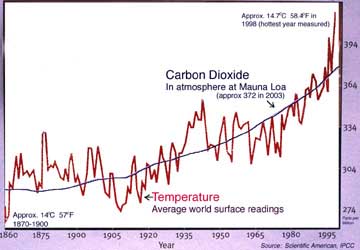
New artic ice core studies reveal CO2 at highest levels in 650,000 years, and six ice ages. We experience atmospheric CO2 levels of 27% higher than past peaks periods.

The European team's leader, Thomas Stocker, of the University of Bern, said the research showed that "the timescales on which humans have changed the composition of the atmosphere [are]extremely short compared to the natural time cycles of the climate system".

Carbon dioxide levels are now 380 parts per million, compared with previous peaks of below about 300 parts per million.

The ice core study, published in yesterday's issue of Science, confirmed that temperatures have been closely tied to greenhouse gas levels throughout this period in a way that climate modellers had predicted.

Three of the previous six interglacial periods were also found to have lasted nearly 30,000 years, much longer than the 10,000 years or more of recent interglacial periods. This meant, fortunately, that another ice age was not due for 15,000 years, the researchers said.

In other news new research shows that sea levels have been rising by 1mm per year to around 1850, after which they started rising by 2mm per year.

Technorati Tags , , , ,

Thursday, November 24, 2005

Great, bleach barrier reef algae!

Hopeful evidence that reefs may have some resistance to climate change and the feared 'coral bleaching' is emerging from the Australian Institute of Marine Science and CRC Reef Research Centre.
Scientists believe corals may be able to protect themselves from devastating bleaching events after discovering some can adapt to climate change.

The find, described by Ray Berkelmans as "tremendously exciting", comes amid predictions that the Great Barrier Reef could be wiped out by the end of the century because of rising water temperatures.
The good scientist goes on to say his studies had found coral could adapt to climate change by using a type of algae to become thermally tolerant.
"Through an extensive transplant experiment and also through laboratory temperature stressing experiments we were able to determine that, at least for the species that we were looking at, under some conditions the corals were able to take on a new type of algae into their system," he said yesterday.

"There are different types of algae that it can associate with and when it associates with a particular type called D, it becomes more thermally tolerant. That's a tremendously exciting find. Up until recently we weren't sure that corals could adapt at all.

"We found instances where individual corals change the dominant zooxanthellae (algal partner) type from type C to D after a major stress event," he said. Type C is found in more than 95 per cent of the reef.

"It's evolution within the lifespan of an individual coral, and that's the exciting part."

Dr Berkelmans said the find gave scope for optimism that corals could survive future bleaching events, but some questions remained: "We don't know which species; we don't know where; we don't know why."
And so might some of the enormous biomass that the world's coral reefs support, recycling CO2 through the carbon cycle and having a moderating effect on the rate of climate change.


Technorati Tags , , , ,

Monday, November 21, 2005

Mother Earth important as unborn child: Aussie Bishops

Fresh from debunking Intelligent Design, Australian Catholic leaders are striking another blow for common sense:

Australia's 5 million Catholics were as morally bound to combat the loss of biodiversity as they were to protect the rights of the unborn child, according to a landmark statement by the church's bishops that calls for Australia to cap greenhouse emissions.

The nation's 30 Catholic bishops said ratifying the Kyoto Protocol was the least that Australia could do to continue to "support international structures that help reduce global warming".

Their extraordinary statement on climate change points to a converging partnership between church leaders, environmentalists and scientists, giving moral force to public campaigns to win environmental safeguards. It forms part of a national church strategy to mobilise Australian Catholics to face the changes required to tackle global climate change.

As always the Anglicans are taking things one step further.
In July, a key international body of the Anglican Church declared the wilful destruction of the environment to be a sin.
Getting back to the Catholic Bishops, these guys have a plan as well as a prayer.
A critical part of the solution was in the development of alternatives to fossil fuels.

"As pastors of more than a quarter of the Australian population, we urge Catholics as a matter of conscience to co-operate in facing global warming as one of the major issues of our time, and take roles of responsibility proper to them."

The scientist and author Tim Flannery applauded the bishops' statement, saying it was immensely helpful to furthering the debate on climate change and mobilising individuals to change their lifestyle.

"The debate about climate change is not a debate between left and right, religious and non-religious. It's about holding onto the old economy, on one hand, or moving forward to better our future."

The church's position paper was presented by Bishop Christopher Toohey last night at a climate change conference hosted by Catholic Earthcare Australia.

Copies will be sent to more than 4000 parishes, schools, religious congregations and church agencies.

It will be followed by an updated audit which urges them to switch to more sustainable practices, including use of gas or solar heating and green electricity, grey water recycling systems, car pooling and ethical investment policy for savings.

Technorati Tags , , , , , , ,

Saturday, November 19, 2005

Australia 23% increase in emissions over 13 years

A report prepared by the Bonn-based United Nations Climate Change secretariat and released this week ahead of the international climate conference in Montreal later this month warned that the western world was losing its grip on the climate change problem.
The report, covering the period between 1990 and 2003, found Australia's greenhouse gas emissions had risen 23.3 per cent on 1990 levels.
I believe Australia has the biggest or second biggest ecological footprint per capita, so it's not like we are coming off a low base here.
The Australian Government's target is to limit emissions increases to 108 per cent of 1990 levels over the period 2008-2012.
Yea, right! But what of the oft heard arguement that limiting emissions would limit our GDP? The opposition is testing that claim.

"Given Australia is on track to be having the hottest year on record, it's clear the Howard government is fiddling while Australia is burning," opposition environment spokesman Anthony Albanese said.

"Having acknowledged the threat posed by climate change, the government has to take action to address this crisis."

Mr Albanese said Britain's 13 per cent reduction in its emissions since 1990 had coincided with 38 per cent growth in GDP, proving that good environmental policy could also be good for the economy.
It's not all bad news though.
UN researchers found that overall in the industrialised world, greenhouse gas emissions were down 5.9 per cent in 2003 compared to the 1990 levels.
Technorati Tags , , , ,

Monday, November 14, 2005

2005, hottest year on record, almost.

We can't say that 2005 is the hottest Australian year on record. Yet. But it is looking that way:
the 10 months from January to October were the warmest since monthly records began in 1950 and would probably make it the hottest year since annual records began in 1910.

In the first 10 months this year, temperatures were 1.03 degrees celsius above the 30-year average.

This year's was the warmest September for 125 years.
Repeat after me whilst fanning, "global warming is not happening, not happening, not happening".

Technorati Tags , , , ,

Sunday, November 13, 2005

Saab 9-5 BioPower Flex-Fuel UK launch

From: Jonathan Fry

E85, carbon neutral petrol, has a higher octane rating than unleaded petrol. Saab have engineered an engine that harnesses the higher oxygen content to burn more cleanly, reduce emissions, particulate matter and deliver performance.
Because Saab's turbocharging technology and engine management systems make it possible to take advantage of bioethanol's higher octane rating, an impressive 20 per cent gain in brake horse power (bhp) and 16 per cent growth in torque can be enjoyed when the car runs on E85 compared to when running on regular petrol.
Ethanol, made from renewable biomass such as sugar-cane, sugarbeet, etc., is mixed with 15% unleaded petrol to make E85, which turns out to be the right ratio to achieve carbon neutrality.
Unlike petrol and diesel, the consumption of E85 does not significantly raise atmospheric levels of carbon dioxide (CO2), which is the greenhouse gas that, according to some scientific research, contributes to global warming. This is because the emissions that are released from the combustion of bioethanol whilst driving are cancelled out by the amount of CO2 that is removed from the atmosphere, through the natural photosynthesis process, when the crops for conversion to bioethanol are grown.

Technorati Tags , ,

Saturday, November 12, 2005

# 2 link added: worldwide-disasters.com

For a snapshot of the world's problems you can't go past the subject index of Worldwide-disasters.com. The Pandemics section currently tracks Bird-Flu progress.

Categories
Admin (1)
Drought (1)
Earthquakes (9)
Flooding (8)
General (2)
Global warming / Climate change (12)
Hurricanes (44)
Misc (2)
Pandemics (69)
Pollution (1)
Tornadoes (3)
Tsunamis (1)
Typhoons (2)
Volcanoes (2)

Technorati Tags , , , , ,

Wednesday, November 09, 2005

Frisky lizards in climate change warning


The blue-tongue lizards of my home state are now mating early as mother nature tell us that the climes are a-changing:
As a result, its behaviour - along with other native flora and fauna - is being catalogued for an ecological database that meteorologists hope will give an insight into climate change and its effect on nature.

Dr Lynda Chambers helped establish the database at Melbourne's Bureau of Meteorology Research Centre after noticing "astounding" behavioural changes.

"Change to plant and animal behaviour is nature's own yardstick," she said today.

"When we see and record ecological changes, it's an indicator of how the climate is changing.

"The Sleepy Lizard is now mating weeks earlier due to the warmer and drier winters
.
Dr Chambers' work will be presented during an international conference on greenhouse and climate change at Melbourne from November 14-17. She records changes across the board.
"The fact that so many different species are exhibiting changes is quite astounding."

Sunday, October 30, 2005

Amazon source at 36 year low

Key points

  • Worst drought in 42 years prompts declaration of State of Emergency in Amazon River delta.
  • 1000's of towns and villages cut off from outside world as falling water levels make river unnavigable.
  • The level of the tributary Rio Negro, has dropped 12 metres since July to just 16 metres.

Is this linked to global warming? Carlos Rittl, Greenpeace Brazil's climate campaigner says 'yes':

Greenpeace blames deforestation and climate change for the drought. "The Amazon is caught between these two destructive forces, and their combined effects
threaten to flip its ecosystems from forest to savannah," Mr Rittl said
.
Even if the drought is not a result of GW it will certainly contribute to it, given that a lot of sunk carbon in the form of biomass, ecosystems and food-chains threatens to be released into the atmosphere.
To make matters worse, as the rainforest becomes increasingly dry, damaging wildfires are regularly breaking out across the region, destroying trees.
Reference: The Sun-Herald, Oct 30, 2005: Mighty Amazon close to running out of water

Technorati Tags , , ,

Wednesday, October 26, 2005

Oceans reservoir for earth's heat energy.

A recent history of GW science.

If James E. Hansen of the NASA Goddard Institute for Space Studies in New York was right in 1997 saying that the earth is absorbing about 0.5 watt per square meter of sunlight more than it is emitting back to space, then where is the heat going? Hansen speculated it was probably in the oceans. Support came in 2000 from Sydney Levitus of the National Oceanographic Data Center in Silver Spring, Md:
That knowledge inspired Levitus and his colleagues seven years ago to launch a United Nations-sponsored global search?and-rescue operation for ocean data. The team?s primary goal was to dig up every single temperature measurement they could find for the top 3,000 meters of the ocean, enough water to engulf a skyscraper seven times as tall as the World Trade Center. They knew that the deeper they looked, the more convincing any emerging temperature trends would be.
Numbers came in from all over the world. When the British Royal Navy told Levitus that it had hundreds of thousands of index cards of hand-written temperature profiles stashed away in a musty basement, the oceanographer jumped at the chance to add them to his growing database. He didn?t have to go far. Officials loaded a ship with some 100 metal file drawers full of the cards and sent them across the Atlantic. His team also uncovered unexpected measurements from World War II at the Scripps Institution of Oceanography in San Diego and rare numbers from the icy seas around Russia and Norway in an obsure book tucked away in the New York Public Library.

When they put the millions of numbers they gathered together with several million more that already existed, they discovered that the Pacific, Atlantic and Indian oceans combined warmed an average of 0.06 degree Celsius between 1955 and 1995.
What?s more, that amount of warming accounts for a majority of Hansen?s "missing heat."

Reference: ScientificAmerican.com April 17, 2000

# 1 link added: terry*

* in which we have chosen the name "Terry" for our website. In case you are wondering, it is an affectionate term for the word "Terra."

This great Canadian site aims to combine art, news and geo-science. I am pleased for it to be my first link. Terry recently updated with an informative article on the developing field of Climate Modeling; what it is and why it is important.

Global warming is happening. Are we to blame or is it a natural
warming trend? Is reducing our CO2 emissions going to have any effect on
dampening this process or is it too late? How much is the earth?s temperature
going to increase in the next century and will the earth be inhabitable for
anything more than cockroaches? Climate modeling has the potential to answer
these questions. It is even more important given the influence the scientific
community can and does have on government decision making. To combat global
warming tough decisions need to be made by policy makers that may involve
sacrificing short term benefit for long term gain. Policy makers, though, are
responsible for the well being of their constituents and will only make these
tough decisions if they are given valid scientific evidence that shows the dire
consequences of not acting now. This is what climate modeling is attempting to
do.

With the economic livelihood of a good portion of the earth?s population relying on the production and consumption of fossil fuels there are a lot of questions to be answered. One thing is certain, Climate Modeling has a big future.

Tuesday, October 25, 2005

Gums have reason to be blue

Yesterday's article prompted this creative solution to the drought in today's SMH Letters To The Editor.

Down with those gums

Given the reported link between vegetation clearing, urban sprawl and thunderstorms ("City climate surprise - trees cut, storms grow", October 24), can I suggest we tear down those pesky gum trees and whack a few new suburbs in the Blue Mountains National Park, thereby guaranteeing that when it rains it finally does so over the catchment area?

Stephen Driscoll Carlingford

Technorati Tags , , ,

Monday, October 24, 2005

Research: Sydney southwesterlys gather speed over tree-free west.

"We think the removal of the forest in western Sydney has allowed storms to move across a little quicker."

Macquarie University physical geography department researchers Professor Andy Pitman and his student colleague, Anna Gero, have discovered that their computer simulations of Sydney weather patterns with and without the original vegetation cover suggest that the changing landscape and specifically the western urban sprawl is also responsible for increasing the violence of some storms.

It also appeared the vegetation loss had changed the dynamics of atmospheric convection, which is a key to forming many thunderstorms that strike Sydney on summer days. Without the vegetation, sea breezes could sweep further inland, changing the location where they collided with winds blowing from the south-west. The biggest storms in the simulations formed over the central business district. Professor Pitman said they first thought the storms were being powered by turbulence caused by city buildings, "but we found it was really the cleared space south of Sydney".

The weather bureau's NSW regional director, Stephen Lellyett, said: "Upon a cursory examination, [the] work is very interesting - it appears plausible that the speed and intensity of systems tracking south-west to north-east could be modified by changes to the behaviour of the sea breeze and be a result of land-use change."
Ok, but how is this on-topic? I do observe how Sydney storms seem to be getting worse and had quietly wondered whether this was due to global warming, greenhouse gas style. If Professor Andy Pitman and his student colleague are right it is good news. The increasing serverity of storms has localised causes, at least to some extent. Re-treeing the backyards, parklands and open spaces of western Sydney could help create a storm-break that will help reduce the severity of our storms.

Technorati Tags , ,