Showing posts with label Changing Animal Behaviour. Show all posts

Saturday, May 26, 2007

Are recent zoo breakouts a climate change warning?

After last week's gorilla escape from a Northern European zoo, we see listed next to BBC News Video reports on the harbingers of climate change, more primates breaking out of zoos.

Given that animal instinct is far more alert to impending natural disaster than ours is, could the recent behaviour also be a harbinger? A forewarning? Perhaps not as dramatic as the dolphins leaving the planet after failing to warn us humans of impending planetary demolition and leaving us with a polite, "So long and thanks for all the fish." in Hitch-hiker's Guide to the Galaxy, but the unseasonal European spring is dramatic enough in it's own rite.
clipped from news.bbc.co.uk
Home of BBC News on the Internet

Sci/Tech

RECOMMENDED

  1. Warm spring 'affects wildlife'
    A warm spring has brought about the early arrival of some UK wildlife, according to the Springwatch survey.
  2. Britain's gardens 'vanishing'
    Environmentalists have warned that a fall in the number of suburban gardens is damaging wildlife.
  3. Escaped orangutan runs riot

Saturday, January 20, 2007

Wealthy swordfish do Norway & Greenland for school holidays

It's all too easy to blame fossil fuels for global warming, but they have brought prosperity unknown in previous generations of tropical swordfish. So much so, in fact, that there have been frequent sighting of holidaying swordfish recorded off the coast of Norway and Greenland. :::[SMH]

Parts of the North Atlantic are setting winter heat records, allowing species ranging from swordfish to jellyfish to thrive beyond their normal ranges in a shift linked by many scientists to global warming.

Temperatures in Arctic waters off northern Europe at the tail end of the Gulf Stream, for example, are about 6.7 Celsius, the highest for early January since records began in the 1930s, according to Norway's Institute of Marine Research.

[...]

In Lista by the North Sea, for example, water temperatures were a record 8.5C, 2-3 degrees above normal for January.

In recent years, salmon have been seen swimming north of the Bering Straits between Russia and Alaska, and jellyfish plagued Mediterranean beaches in 2006. Over-fishing and destruction of habitats is also disrupting marine life.

Many scientists link high global air and water temperatures in recent months to an El Nino weather event warming the eastern Pacific, and to global warming stoked by burning fossil fuels.

The longer-term warming trend is affecting all oceans.

"The Indian Ocean has had an overall warming trend attributed to the overall warming of the oceans," said Nerilie Abram of the Australian National University.

Abram said droughts in Indonesia and perhaps Australia might become more frequent as a result of changing ocean and monsoon conditions.


Global warming alarmists would deny swordfish their new found mobility. They would turn back progress and condem these magnificant creatures back to their humble beginnings in Australia, back to being hunted by wealthy tourists from Norway.

Technorati Tags

Friday, June 09, 2006

Global warming? Bring it on if you breed quickly.

The meek on global warming shall not inherit the earth.

If God's creatures, small, are anything to go by it looks like that honour may go to the lustful and libidinous, the lubricious and licentious. Or rather the reproductively rapid.

The recent discovery that some species of animals are evolving to adapt to rapid climate change within just a few generations gives us an idea of who or what may be left on board when our 21st century Noah's ark, what I call the planet, comes to metaphorical rest once our carbon dioxide levels stabilise and/or subside: :::[The Independent]

Smaller animals in particular that can breed quickly, such as squirrels, some birds and insects, are showing signs of evolving new patterns of behaviour to increase their chances of survival. Scientists say that many of the genetic adaptations are to cope with changes in the length of the seasons rather than the absolute increases in summer temperatures.

Larger animals and species that are slow to reproduce may on the other hand find it difficult to cope with climate change because they cannot adapt genetically as quickly as smaller, more fertile creatures that have rapid life cycles.


Christina Holzapfel, from the University of Oregon in Eugene says that, "Studies show that over the past several decades, rapid climate change has led to heritable, genetic changes in animal populations.". The Canadian red squirrel is reproducing earlier in the year, German blackcap birds migrate and arrive earlier at their nesting grounds and even northern American mosquitoes are adjusting their lifecycles to shorter days.

In the past it has been noted that animal species are extending their ranges by migrating north (and presumably south) to higher latitudes where global warming is causing longer growing seasons at a faster rate than towards the equator. This has been called 'phenotypic plasticity', or the ability of individuals to modify their behaviour, morphology or physiology in response to altered environmental conditions, but what we are also witnessing is heritable genetic adaptations to changing seasons.

So where does that leave us humans? Mice can outbreed us by a factor of 10,000 to 1. If we don't want the squeak to inherit the earth, if we don't want to say hello to the unicorn, we need to act now to change climate change.

dna

Other posts of global warming animal adaption and non-adaption:
  • Frisky lizards in climate change warning.
    The blue-tongue lizards of my home state are now mating early as mother nature sings out that the climes they are a-changing.
  • Natures climate change canary cooking.
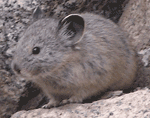
  • The only way is up for the American Pika as it seeks to adjust to global warming. Very sensitive to hot temperatures, their 1200 years migration from the great American plains has found them in alpine terrain
Technorati Tags

Thursday, January 05, 2006

Nature's climate change canary cooks

Pika's are related to rabbits and are considered our most sensitive climate change early warming detector
The only way is up for the American Pika as it seeks to adjust to global warming. Very sensitive to hot temperatures, their 1,200 years migration from the great American plains has found them in alpine terrain, the windswept no-man's-land above tree line, in search of their ideal cooler temperatures. This from National Wildlife Magazine entitled "No Room at the Top".

But biologists like [Chris] Ray now fear that these hearty creatures may not survive global warming. Unlike many wildlife species that are shifting their ranges north or to higher altitudes in response to changing climate, pikas and other alpine animals have nowhere else to go. In some locations, entire pika populations already have disappeared. Scientists say the animal's decline, like the proverbial canary in a coal mine, may presage problems for other species, from butterflies and birds to large mammals.

The extinction of the pika will be another harbinger of global warming.
In the Great Basin, the arid region between the Rocky Mountains and California's Sierra Nevada, pikas already are disappearing. According to National Park Service biologist Erik Beever, the mammals have recently disappeared from 8 of 25 mountainous locations where they were documented in the early 1900s. Beever, who published his discovery in the Journal of Mammalogy, says the die-off indicates that suitable habitat is shrinking. Notably, the most recent pika losses occurred at the warmer, southern end of the animals' range. "This is what you would expect from rising temperatures, a loss at the margins of their distribution," says Beever. The finding represents "one of the first contemporary examples of a North American mammal exhibiting a rapid shift in distribution due to climate."

Technorati Tags

Wednesday, November 09, 2005

Frisky lizards in climate change warning


The blue-tongue lizards of my home state are now mating early as mother nature tell us that the climes are a-changing:
As a result, its behaviour - along with other native flora and fauna - is being catalogued for an ecological database that meteorologists hope will give an insight into climate change and its effect on nature.

Dr Lynda Chambers helped establish the database at Melbourne's Bureau of Meteorology Research Centre after noticing "astounding" behavioural changes.

"Change to plant and animal behaviour is nature's own yardstick," she said today.

"When we see and record ecological changes, it's an indicator of how the climate is changing.

"The Sleepy Lizard is now mating weeks earlier due to the warmer and drier winters
.
Dr Chambers' work will be presented during an international conference on greenhouse and climate change at Melbourne from November 14-17. She records changes across the board.
"The fact that so many different species are exhibiting changes is quite astounding."