Sunday, April 30, 2006

What would you do with $500 billion?

If you feel like winning $50 USD and telling us all what America could have done with the $500 billion that they are likely to spend on the war in Iraq then put on yer tinking cap and wroite up a storm and send it to 500billion.com.

Link :::[500billion.com]
Here is my submission.

Other blogs on: , ,

Push Irans's buttons for one helluva blast.

Call me old fashioned, but this has got to be the most logical thing I have read about concerning the Iran nuclear stance. :::[SMH]

Australian peace activists say threatening Iran with a nuclear strike is the quickest way to ensure it develops its own nuclear weapons.

I am working on a theory that GW Bush was so protected from kindergarden onwards that he has not even the rudimentary notions of how playground psychology works, let alone that of the international scene. He has also been protected from a half decent education, and this explains why he is so misunderestimated by those of us who learnt something at school.

Technorati Tags: , , , ,

Saturday, April 29, 2006

The phoney science in State of Fear

James Hansen, directors of the Columbia University Earth Institute and Goddard Institute for Space Studies responds to allegations by Michael Crichton that he made predictions about global warming that turned out to 300% too high:

Michael Crichton's latest fictional novel, "State of Fear", designed to discredit concerns about global warming, purports to use the scientific method. The book is sprinkled with references to scientific papers, and Crichton intones in the introduction that his "footnotes are real". But does Crichton really use the scientific method? Or is it something closer to scientific fraud?

Hanson neatly dispatches Crichton and concludes with the following grave warning about the seperation between science and the state:

So how did Crichton conclude that our prediction was in error 300%? Beats me. Crichton writes fiction and seems to make up things as he goes along. He doesn't seem to have the foggiest notion about the science that he writes about. Perhaps that is o.k. for a science fiction writer.

However, I recently heard that, in considering the global warming issue, a United States Senator is treating words from Crichton as if they had scientific or practical validity. If so, wow -- Houston, we have a problem!

Source :::[Michael Crichton's "Scientific Method"] by James E. Hansen
Discussion of Crichton's science fiction by real climate scientists :::[realclimate.org]

Other posts on Michael Crichton or the "global warming debate"
Tags: , , , ,

Wednesday, April 26, 2006

Nuclear power is just not an option.

"Chernobyl opened my eyes like nothing else. It showed the horrible consequences of nuclear power, even when used for non-military purposes."
Michael Gorbachev
April 2006.

Australia is set to become the world's leading exporter of uranium to China based on a promise by the Chinese leadership to never, ever use Australian uranium in nuclear weapons (and presumably to never use such a weapon on us or our interests). John Howard has not even ruled out Australia using nuclear power:

"My philosophy is that if it became economically attractive, I would not oppose [nuclear power] any more than I oppose the export of uranium."

While we brace ourselves for a nuclear future, it is worth considering the past. It was 20 years ago that the Chernobyl nuclear reactor melted down, and Russian authorities are still trying to contain the fallout. There is a 30 kilometer security radius around the site. The IAEA believe that radiation exposure will lead to the deaths of 4000 people. There have been 4000 cases of thyroid cancer, mostly in children. Over 350,000 people were displaced.

After more than 50 years we still do not have an answer to the vexing issues of nuclear proliferation, or nuclear waste.

It is also expensive. Those who champion nuclear power as an alternative to fossil-fuel emissions may not know just how much:

On March 30 Britain estimated it will cost $170 billion to clean up its 20 [decomissioned] nuclear sites. In the US, direct subsidies to nuclear energy totalled $115 billion between 1947 and 1999, with a further $145 billion in indirect subsidies. In contrast, subsidies to wind and solar energy combined during the same period totalled only $5.5 billion. Those costs don't include the black hole of nuclear waste - because there is no solution.

There is enough civil plutonium reprocessed worldwide, about 250,000 kilograms, to generate 60,000 nuclear weapons. Clandestine nuclear weapons are easier to make. Mohamed ElBaradei, the head of the IAEA warns about this potential for proliferation, "Our fears of a deadly nuclear detonation...have been reawakened...driven by new realities. The rise in terrorism. The discovery of clandestine nuclear programs. The emergence of a nuclear black market."

Anthony Albanese, the federal Opposition environment spokesman is urging us to consider these realities in holding the nuclear debate. His conclusion is that we should instead be leading the world in the adoption of clean energy, and be part of the $1 trillion industry that is emerging globally in carbon-friendly technologies. ::: [SMH]


Tags: , , , ,

Cost of gasoline will be peanuts.

With rising petrol prices one Australian scientist, Peter Gresshoff, is looking at peanuts, soyabeans and other legumes high in oil in order to produce and efficient biodiesel.

Professor Gresshoff, the director of the Australian Research Council Centre for Excellence for Integrative Legume Research believes gain legumes offer bigger environmental rewards than cane sugar based ethanol. He said a pilot plant making soyabean biodiesel could be operating in five to eight years. Peanuts, with a slightly lower oil content, will be next. ::: [Sydney Morning Herald].

It is not quite a new idea, over 100 years ago, at the Paris World Expo, the inventor of the diesel engine's Rudolph Diesel first demonstrated his internal combustion engine running on peanut oil.

Tags: , ,

Now Michael Crichton sueing Dan Brown.

Came across this clever quip:

[2006.04.08 - 10:00 A.M.]

So the guy who accused Dan Brown of stealing the idea for the DaVinci Code lost his court case. Brown might not be in the clear yet, however. I hear Michael Crichton is suing him next. It appears that Crichton holds a patent on the business methodology of "formulaic, linear plots populated by two-dimensional characters". I know, you wouldn't think they'd let you patent something like that, but there you go


Technorati Tags , ,

Tuesday, April 25, 2006

In defense of global warming 'alarmism'.

The Wall Street Journal's OpinionJournal is devoting a fair few column inches to global warming skeptics lately. A few weeks ago Dr Richard Lindzen claimed that scientists are persecuted for dissenting from the scientific mainstream view that the global warming we are experiencing now is man made. And on Earth Day a hatchet piece called Breathe Easier told us not to believe global warming claims because, well, the past dire predictions of the greens in the 70s have not come to pass:

In the 1970s, prominent greens were issuing dire predictions about mass starvation, overpopulation and--of all things--global cooling. Since then, population-growth estimates have come way down, biotechnology advances have found ways to feed more people than the doomsayers believed possible, and the global-cooling crisis has become the global-warming crisis without missing a beat.

There's no doubt the greens have succeeded in promoting higher environmental standards, which in turn have contributed to cleaner air, water and land almost everywhere you look...........But environmental activists don't want to believe their own success, much less advertise it. They need another looming catastrophe to stay relevant, not to mention to keep raising money.

Much of the article is a vilification of those concerned about the environment. My first response is to laugh at how stupid the unknown author must think his audience is and move along, but when you remember that insidious pieces like these are funded by the fossil-fuel lobby to successfully sow confusion about global warming science, it is worth pars or two of effort to respond.

Name: Wadard
E-mail: j0hnp0p3@yahoo.com.au
City/State: Sydney, Australia
Date: Sun, April 23rd, 2006

Subject:
Re: Breathe Easier

Comment:
How do you congratulate them for the gains they have helped make - like enormous CFC reduction - but criticise environmentalists for that which did not come to pass, like total ozone depletion?

Surely it is more rational to take their warnings even more seriously?

Global warming 'alarmists', such as myself, are simply saying that if we keep putting more carbon dioxide in the atmosphere we will suffer dire consequences to the ecosystems that we depend on. Unfortunately the scientific consensus agrees.

Accusing us of alarmism is misrepresenting us though exaggeration. Our 'alarmism' makes as much common sense as pointing out that if one jumps off a big enough cliff that person is going to die a really unpleasant death. There is nothing scary in that, unless you think someone is planning to jump.

That's because, in my simile, we are all tied together by a rope at the edge of that cliff.

Wadard
Global Warming Watch
Other posts about global warming skeptics and how they work:
Technorati Tags , , ,

Monday, April 24, 2006

When your time is up, your time is up.

Off topic, but the bizareness of it caught my attention: Twenty seven year old Californian man, at home with wife, doing his own thing. Ground opens up right beneath him and swallows him whole. Wife unharmed.

Tags: , , , ,

Global warming state of the debate: Skeptics vs 'Alarmists'

If you come across a stubborn skeptic, direct them to this enlightening graphic from The Age which outlines where the debate is at. Those for or against recognising man-made global warming will have to agree the report is clinical, factual and unbiased. What it shows is that there is a scientific consensus that global warming is happening, and that most of the 'debate' is happening outside of the scientific establishment, and therefore isn't a scientific debate. In response to media reporting the latest science, the opinion pages of newspapers and policy making think tanks run hot with a generalised retort that either rehashes existing GW-skeptic talking points, or comes up with the newest hatchling from the fossil-fuel lobby's propaganda battery.

A good example is the attack on 'greenies' and environmentalists for their past dire warmings that did not come to pass (usually because action was taken to avert the crises of the time, such as CFC reduction contributing to a thickening of the ozone layer hole).

When the critics actually want to stop heckling from the audience and get into the ring to slog it out in peer reviewed science journals, then I am interested. Until then it is not a real debate about the science or the causes or effects, but a really debate about what we should or shouldn't do in response, with the skeptics implying that doing something is going to cost economic growth.

Tags: , ,

Saturday, April 22, 2006

ExxonMobil fingered on global warming emissions.

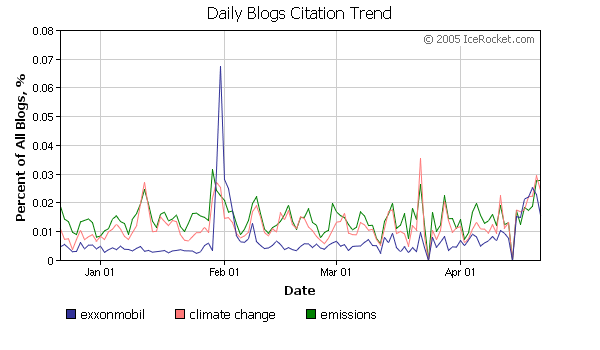
A funny thing happened on the way to the thinktank. All that money ExxonMobil pours into generating global warming doubts is backfiring like an old exhaust according to graphs I generated on IceRocket's search term trends tool. The correlations between the terms "global warming", "climate change", "emissions" and "Exxon" are extraordinary. Here is a graph showing three of the terms over the last month. You are going to have to click on the graph for a much clearer image.


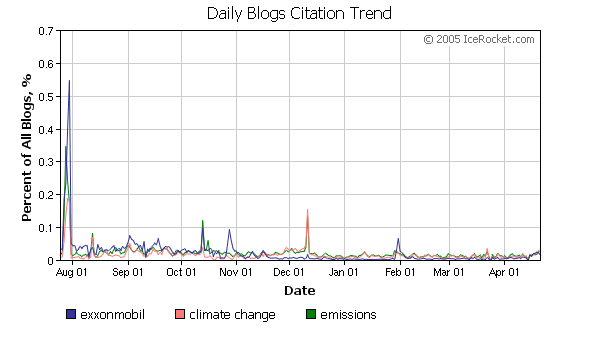
I have omitted "global warming" as a search term here because it Global warming search terms over 1 monthhas about twice the incidence of climate change and such a scale renders the graph less useful when looking at terms of lower incidence, such as "Exxon". But the correlation is extremely high, as one would expect (see yesterday's post). People think "global warming" and they think "climate change", simple as that. global warming search terms - 3 monthsThe graph also shows that when bloggers write about climate change, and they write about emissions - not too much of a surprise. But they also seem to associate ExxonMobil with those emissions and that climate change. Coincidence? Let's look at longer periods to see how the correlations hold up. The next three graphs are forglobal warming search terms - 9 months the last three, four and nine months of search terms.

They hold up.

Why does ExxonMobil have this association in peoples minds? (I also tested the term "Shell Oil" for similar correlation and there was none apparent).

My theory is that all the millions and millions of dollars that ExxonMobil pours into confusing the public has resulted in an enormous miscalculation. While it is financially good for their shareholders (Exxon made $36.2 billion profit last year) to deny any connection between fossil-fuels and global warming the public are not being gulled. As I reported yesterday 71% of Australians, a non-Kyoto Protocol country, believe that it is time to start fighting global warming. This is a similar percentage to those in the US (76%) and in India (71%) who believe that steps must be taken even if there is an economic cost. The public knows there is global warming, and it seems bloggers know who to blame. When governments finally come around to reflecting the common will, there will be one record profit posting oil company on the nose for destroying the climate while lying about not destroying it.

ExxonMobil is winning the war, but losing the battle.
Technorati Tags

Friday, April 21, 2006

71% of Australians want to fight global warming

If 71 percent of Australians believe it is time to start addressing the consequence of global warming, and if we are growing at .8 percent per month there will be a political consequence for politicians uncommitted to action. By January 2007, the start of a federal election year, we will have 75.8 percent of Australians saying we should be taking actions to fight global warming at this rate.

So expect a lot of activity by the fossil-fuel lobby groups. Expect our opinion pages to be saturated with the sentiments of climate 'scientists' venturing that 'global warming is natural', but don't call then scientists unless they have also had their claims peer-reviewed and published in respected scientific journals. Disregard any opinion maker's suggestion of hubris, that it is an arrogance to imagine that mankind can affect our global climate, for it is a parched earth that the meek shall inherit.

Expect economists to opine that reducing emissions will damage economic growth. Expect evidence lite economics. Point out that the smart side of the business side of town has calculated that Australia can reduce emissions by the magic 60% of 1990 levels by 2005 without sacrificing the economy. Maybe just a few politicians, and an oil company exec or two, that's all.

And expect Wadard to be taking the fight to these global warming skeptics, renting their myths apart like cheap fabric to expose their fallacies and threadbare logic.

Other posts on global warming skepticism
Tags: , , , , ,

Global warming bloggers hard at it

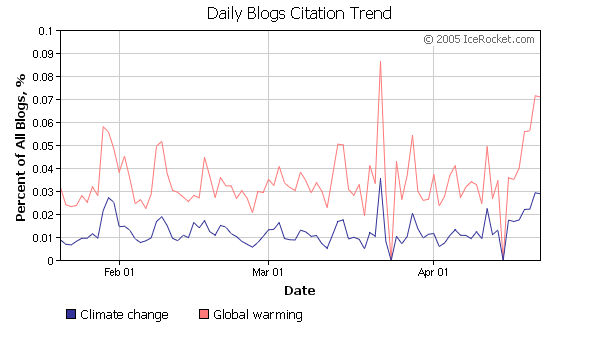
Ice Rocket has a great search term trend tracker, and it has charted an average of 492 posts per day for the last three months that contain the term "global warming". And about half that number for "climate change". Keep up the good work. (click graph to enlarge).


Note the high degree of correlation of the two search terms.

By the way, if you want to know a little secret I discovered about Ice Rocket; you can manually manipulate the "days=" section of the URL generated after a search-terms graph has been created to look at any number of days up to 270. Don't abuse it if it slows their servers down. I pick low traffic times.

Tags: , , , ,

They don't drought global warming in Goulburn.

The current drought has claimed it's first dam, the Pejar Dam, which services the NSW city of Goulburn, which is now officially empty for the first time in its 25 year old history.

After six consecutive years of below average rainfall, the Pejar Dam, which when full has a capacity of 9,000 megalitres, is now down to just 3 megalitres, the Goulburn Mulwaree Council said.

Now with the water supply coming from Sooley Dam and Rossi Weir, which are both about 90 per cent full, Goulburn had enough water for just 17 months.

Water supply for Goulburn is now only at 30.5 per cent of total capacity. Only 18.5 per cent of this water is of usable quality.

Get used to it.

Other posts about the drought in Australia

Tags: , , , , , ,

Wednesday, April 19, 2006

How to recover quickly from lost blog code

...and only suffer mild side effects.

While I was editing my template last night I inadvertently lost all my sidebar html and code. Typically I didn't have a back-up. It took me a few hours of kicking myself to realise that I do have many copies in Google's cache - which is why I am posting - hopefully to save others time and bruised thighs (don't kick youself if you know karate). No worries mate, she'll be right. I searched for Google for a recent pre-disaster post and clicked on the cached option. There it was, with search terms highlighted. I converted to source code, and easily found my sidebar text. It was useful that I had documented the code with comments, and so does Blogger. I cut and paste into my Blogger template, and I am back to normal.

Almost normal. My original Google search terms are highlighted wherever they appear in the sidebar, and my most recent posts were from the month old source code, over which I cut and pasted up-to-date code. My scripts worked fine.

I am leaving those sidebar terms highlighted as a reminder to back up my blog locally. A lucky escape.

Tags: , , , , ,

Tuesday, April 18, 2006

Study: Global warming greatest threat to species

Loss of biodiversity is bad because it weakens the biosphere which is what stabilises our climate. Less biodiversity means less carbon is cycling through the ecosystem. More is left backing up in the atmosphere as heat trapping carbon dioxide in a nasty positive feedback cycle, accelerating the global warming. It is never good news; when a single species dies off the effect cascades up and down the food-chain ultimately clogging up nature's carbon sink and leading to further loss.

Now a new study says that a rise of just 2 degrees over the next 50 years could wipe out tens of thousands of plants and animal species.

So pervasive would this wave of extinction be, that the study, co-authored by CI's Lee Hannah - says that by the end of this century, climate change will represent a greater threat to biodiversity than deforestation, with important implication to the long-term endurance of our conservation gains. "Climate change is one of the most serious threats to Earth's biodiversity," says Jay Malcolm, the study's lead author and assistant forestry professor at the University of Toronto. "We now have strong scientific evidence that global warming will result in catastrophic species loss across the planet."

The study, supported by the CI, the World Wildlife Fund, and the David Suzuki Foundation researched plants and animals in 25 to 34 biodiversity hotspots. The most vulnerable biodiversity hotspots are the Cape Floristic, Caribbean, Indo-Burma, Southwestern Australia, Mediterranean Basin and Tropical Andes hotspots, where extinctions of plant and animal species in each region could exceed 2,000.

The new study also corroborates controversial findings published two years ago in the journal Natureby scientists from the University of Leeds and CI, that claimed global warming from increased atmospheric greenhouse gasses could drive species to seek cooler latitudes or higher altitudes. But for many specialized creatures already living on mountaintops or islands, there may be nowhere else to go, resulting, the Leeds study said, in the extinction of over a million animal species by 2050.
Source: Conservation Org

Tags: , , , , , , , ,